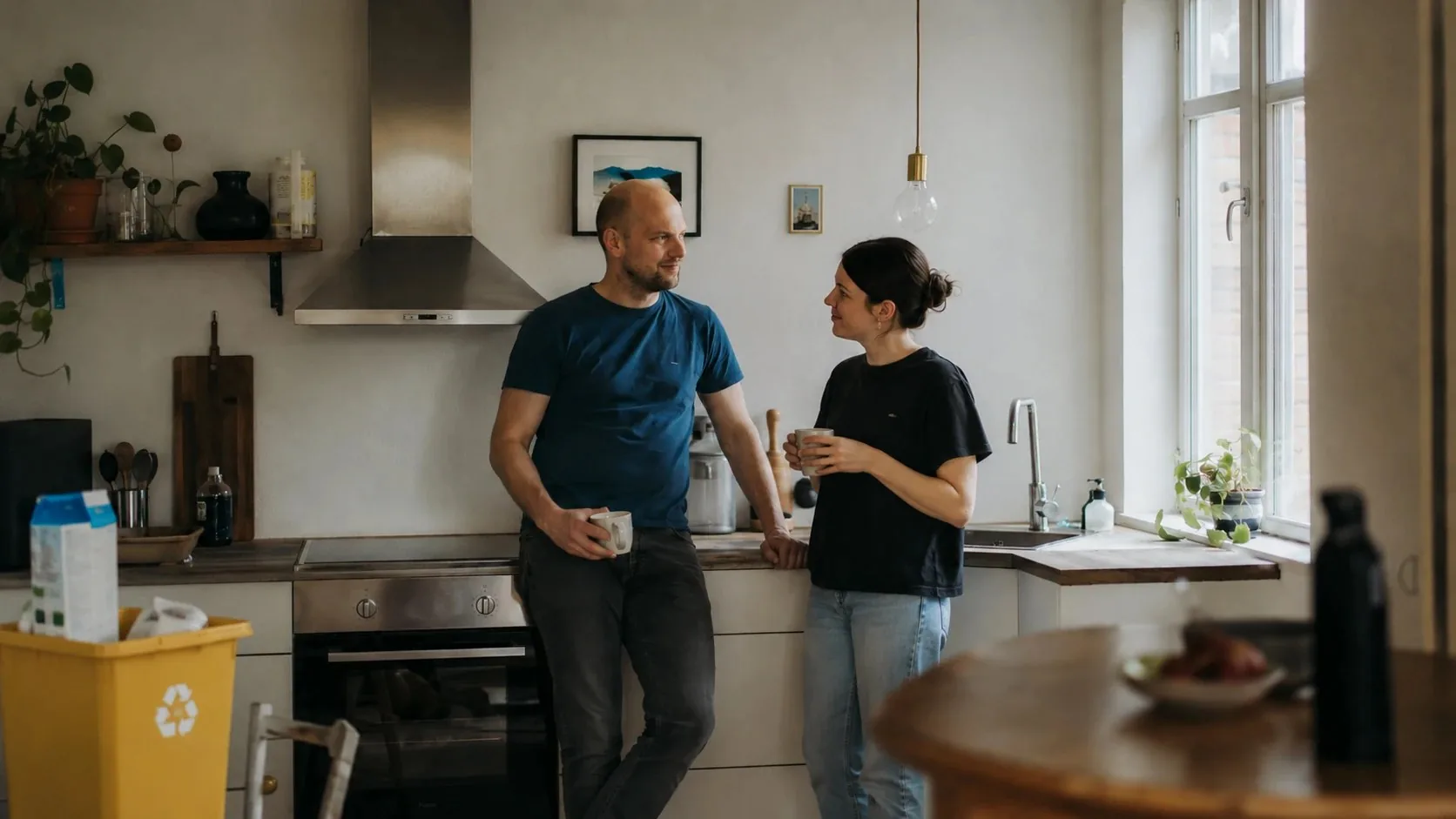
I was standing over the recycling bin, holding a half-empty milk carton in my hand. Not crushed. I tossed it in. And then came the shouting. Real shouting.
It was collection day. The bag was half empty. It was nothing. Honestly, it was about absolutely nothing. And yet there we stood, facing each other like two strangers who had just met and instantly hated each other.
Let me be clear so you don't get the wrong idea: the carton wasn't the reason. Nobody gets divorced over an uncrushed milk carton. It was just the last straw. A release valve. The pressure that had been building in both of us for months finally found the dumbest possible excuse to explode. And explode it did.
The trap of two worlds: the maid versus the wallet
Four months. That's how long our hell lasted. At the end of those four months, divorce papers were lying on the table. Real ones. Filed. Not a threat thrown out in an argument, but paper you can actually sign.
How did we get there? Each of us lived in our own world, and neither of us could see into the other's. She felt like nothing more than a maid in her own home. Every day the same endless routine – kitchen, laundry, food, cleaning, round and round. Thankless, invisible work that is never, ever finished.
I felt like nothing more than a wallet for the family. I went to work, earned the money, handled the insurance, the car servicing, mowed the lawn, sorted out things nobody even thought about – until they stopped working. I poured an enormous amount of energy into it. Physical and mental.
And you know what the worst part was? Nobody ever thanked me for any of it. Because nobody saw that work. The insurance just gets paid. The car just runs. The lawn is just mown. As if it all happened by itself. But she felt exactly the same way. That her work was simply taken for granted. Like air.
We were both grinding away in our own separate sandboxes. Both exhausted. And both convinced the other had no clue what it was really like. Each of us saw only our own half of the picture.
When emotions fail, bring in data
At some point it hit me: we were never going to solve this with emotions. We'd tried. Talking ended in shouting. Shouting ended in silence. Silence ended in paperwork. If you want to compete with someone over who does more, you'll never win – because everyone counts only their own effort and can't see the other's.
So I thought: what if we stopped guessing and started measuring? We sat down. Through a guided wizard, we went through templates for around 130 household activities. Everything – from washing the dishes to swapping the tyres, from cooking dinner to sorting the insurance. And for every single one we set the attributes: how long it takes, how much mental load it carries, how critical it is, how easily someone else could take it over.
I won't lie, it was tedious. Sitting there rating 130 things when you can barely speak to each other is a strange experience. And she didn't believe in it. Not at all. She looked at it like just another one of my silly ideas. "Some app is going to teach us how to live?" I understood her. It sounded crazy to me too.
A mirror that didn't take my side
I'll admit it – somewhere deep down I was hoping the app would finally prove I was right. That it would show everyone how much I actually do. It didn't.
In black and white it showed me that she really does do more of that dense, daily, relentless work. The kind that never ends. I had nothing to stand on. Data is data. And that was the moment that turned us around.
Because in that same instant, the same app showed her something she had never seen either. My invisible mental load. The cars, the insurance, the deadlines, the decisions I carried in my head so she wouldn't have to. Suddenly it wasn't "just money". Suddenly it had a weight she could see too.
It wasn't a robotic manager dividing up chores and saying "right, now get to work". It was a mirror. For the first time in months we both saw the other half of the picture. I gave her full respect for what she carries every single day. She finally saw me. This isn't about an app. It's about understanding – the app was just the tool that gave it back to us.
Why the data reconciled us without naming a culprit
Family Fair Play doesn't just track who took out the bins. Through a load score it weighs each task by its mental difficulty, criticality and how replaceable it is – and a fairness index shows how much of the total burden each member carries. Not as an accusation. As a map that, at last, both partners can see.
The power of ownership: those 15 minutes
Here comes the thing I completely failed to grasp until then. After all this, I didn't start doing half of everything. I didn't turn into a different man overnight. That would be a lie.
I did something else. I took full ownership of a few specific tasks. Watering the plants. Mopping the floor. That's it. It takes me about 15 minutes a week.
And here's what matters: the value isn't in those 15 minutes. The value is that these two things disappeared entirely from her head. Before, even if I happened to do them, she still had to keep them on her mental list, check whether I'd done them, remind me when I forgot – and often end up doing them herself anyway.
That's the difference between "helping" and "owning". When you help, it's still her task and you're just assistance that needs managing. When you own it, it's yours. All of it. The remembering too. The responsibility too.
Those 15 minutes a week didn't mean I was doing more work. They meant two items vanished from her mental list for good. She no longer has to check them. She no longer has to remind me. They're gone. Out of her head. And that, exactly that, brought peace back home. Lasting peace. The divorce papers were withdrawn.
Why Family Fair Play exists
I didn't build an app to launch a business. I built a lifeline for my own marriage. The fact that Family Fair Play came out of it only happened afterwards.
So if you're reading this and something here sounds familiar – the exhaustion, the sense of injustice, the silence at dinner – I want to tell you one thing: don't argue about who does more. You'll never win that argument.
Try to understand each other instead. Through clean data that takes nobody's side. Not so an app can decide who's right – but so you can both finally see the other half of the picture. Do it before you find yourself standing over a recycling bin with an empty milk carton in your hand. Before it's too late.
Author's note: Since I'm not all that good at putting things into words or writing long articles, I had some help shaping the final text. But every situation, every feeling and the whole story I describe here are one hundred percent real and true. No embellishment – just our reality.