Nobody at home is lazy. And it still doesn't work.

Chores can be shared. So can the thinking behind them.

Every task has three phases: noticing, deciding, doing. The first two usually sit in one person's head. Family Fair Play shows who carries which part and helps you agree on who takes over a whole task.

Free for 4 members · invite your partner · no card required

Sound familiar?

Two worlds under one roof. Neither of you can see into the other.

The one who keeps the household running in their head

  • Kitchen, laundry, meals, tidying — round and round. It's never done.
  • It's all in my head. If I forget something, it's my fault.
  • When I say it out loud, it turns into an argument.

The one who keeps the things nobody notices until they stop working

  • Insurance, servicing, deadlines, decisions. I carry it so nobody else has to.
  • The insurance “just” gets paid. The car “just” runs. As if it happened by itself.
  • I try to help and it still isn't enough.

You're both telling the truth. The problem isn't that one of you does too little — it's that neither of you can see the other half.

Roman Bednár, author of the Family Fair Play blog

It wasn't a robotic manager. It was a mirror — and it didn't take my side.

Roman Bednár, PhD.

The founder's story

Why it happens

Four things that explain it — and most couples never name them

This isn't about laziness or personality. These are mechanisms at work in every household.

  1. Every task has three phases: noticing → deciding → doing

    When someone “takes over” a task, they usually take over only the doing. Noticing and deciding stay with the same person — and that's the part you can't switch off.

    Read more: The three phases of every task no one talks about

  2. One person becomes the household's control tower

    It's called the default parent. Every question, every deadline, every “did we forget to…” routes through them. Not because anyone asked — it just happened.

    Read more: The default parent: who becomes the household switchboard everything lands on

  3. You see all of your own work. The other person's only when it happens in front of you

    It's called availability bias. That's why when you both estimate your share, the total comes to well over 100 %. And you're both being honest.

    Read more: From "I feel like I do more" to a shared map

  4. There's a world of difference between “helping” and “owning”

    “Just tell me what to do” doesn't reduce the work — it moves it. While you wait to be told, the list still lives in one head.

    Read more: Why “helping out at home” is part of the problem

The three phases of a task come from Allison Daminger's research (2019). Availability bias was described by Ross and Sicoly back in 1979.

routeHow it gets onto paper

From one head onto one shared page

Three steps. Nothing to invent — the app asks, and works out the rest.

1

You write down what actually happens at your place

Add members and tasks — pick from over 150 ready-made templates, so you're not starting from a blank page. Including the things that were never written down anywhere.

2

The app weighs it, it doesn't just count it

Each task is scored on time, mental load, criticality and how easily someone else can take it over. That's why doing the dishes and planning a holiday don't weigh the same.

3

You both see the Fairness Index

One number instead of two feelings. Not a verdict — a map you can finally look at together.

Add your household
more_horiz
Family members
MK
Mom
TK
Dad
L
Lucia
add
Add
Tasks from templates
local_laundry_service
Washing dishes
add
shopping_cart
Grocery shopping
add
cleaning_services
Vacuuming the living room
add
For the partner who was sent this link

An invitation to look at it together

If someone sent you this link, you're not reading a reproach. What you carry shows up on the map too.

balance

You set the weights together

How much mental load, criticality and substitutability count for is up to you, in the settings. It isn't our verdict on your household.

visibility

Your invisible work shows up too

Insurance, servicing, deadlines, decisions made in advance. Member cards separate physical time from mental load — including yours.

play_arrow

You don't have to promise anything

Open the live demo. It's read-only, no email and no account.

What you'll stop doing

Not another to-do list. Each feature takes one thing out of your head that you carry alone today.

Stop proving who does more
The app measures each member's physical and mental load and shows a Fairness Index you both see. One number instead of two feelings — and nobody has to win the argument.
Stop reminding
The app reminds whoever is responsible when a task is due. When something is stuck, the nudge comes from the app — anonymously, not from you.
Stop building the list from scratch
Answer a few questions and the app prepares tasks for your household — with time and effort already filled in. You edit, you don't type.
Stop quietly redoing each other's work
For each task you agree on a minimum standard — what “done” actually means. Once the bar is clear, nothing has to be redone. Pizza with a side of cucumber is still dinner. Read about the quiet war over standards
Stop chasing the kids
Kids tick off finished tasks themselves on a tablet and collect stars they trade for rewards set by your family rules. The system motivates, not your repeating.
Stop wondering if the grandparents can use itAccessibility
Stronger contrast for weaker eyesight, adjustable text size, dark mode, keyboard navigation and reduced-motion support — built to the European Accessibility Act.
language8 languages, one system: English Deutsch Français Español Polski Magyar Čeština Slovenčina
swipeKids

Kids don't need orders. They need to know what's theirs

When a child has an age-appropriate task and can see it themselves, they stop waiting to be reminded. Stars are the fuel — ownership is the point.

Swipe = done
One task at a time as a card. Right to complete, left to leave for later. No scanning a list.
Confetti and stars
Every completion rewards you with confetti, a star and a gentle buzz. Progress and streak are visible.
For kids and phones
Big cards and one simple gesture — even a younger child can do it. Great on a wall tablet or in your pocket.
Tidying up as a game

Tidying up as a game

Kids earn stars for every toy they put away. Once they reach the goal, a family movie night or a favorite treat awaits.

The founder's story

Family Fair Play wasn't designed at a desk. It started when there were divorce papers on our kitchen table.

I took over two tasks. Watering the plants and mopping the floor, about 15 minutes a week. The value wasn't in those 15 minutes. It was that two items disappeared from her head for good.

Read the full story

smart_toy
New · included in Premium

Control the app with an AI agent

All of Family Fair Play can be driven by the AI assistant you already use. It's a topic of its own — it has its own page.

See how it works with an AI agent

One more thing before you start

Yes, you're the one starting this too.

But the app takes over the explaining.

Creating an account, listing tasks, convincing your partner — that is exactly the kind of work Family Fair Play measures. So it's built to ask you for one step and say the rest for you.

You do once

  1. Answer 5 questions. The app turns them into the 20 most common tasks for your household.
  2. Send your partner one invitation link. No long message, no defending yourself.
  3. Anyone who just wants to look first opens the live demo — no account, no email.

From then on, the app talks

  • The welcome, the reminder about an unopened invitation and the monthly report come from the app, not from you. Shared messages go to both of you at once, in the same words.
  • It reminds whoever is responsible when a task is due. Nudges come from the app — anonymously.
  • Nobody has to prove who carries what. You both see the Fairness Index.

Phone reminders, partner messages and the Fairness Index are part of the Full Picture plan. You can start for free, no card.

sellPricing

Choose your plan

Transparent pricing with no hidden fees. One price for the whole family, no matter how many members.

home

First Look

See how much there really is at home

Free
forever, no card, no deadline
check_circle20 tasks to start — a household has several dozen
check_circle4 household members
check_circleSee what needs doing
Choose plan
starOur pick
workspace_premium

Full Picture

Everything done at home. Including what no one sees.

€19.99/ year
✓ €3.89 a year less than monthly≈ €1.67 per month
check_circleEvery household task — from the bins to the car service
check_circleEveryone who lives there — grandparents too
check_circleHours of work per year for each person — plus the load in their head
check_circleSplit in %: one number instead of guesswork
check_circlePhone reminders, data export and your AI assistant
Start now
all_inclusive

Forever

Full Picture, pay once

€49.99
one payment — the picture stays
check_circleEverything in Full Picture
check_circleThe price of 2.5 years on the yearly plan
check_circleAll future features
Choose plan
lockSecure payment via StripegroupsOne price for the whole familyverified_user30-day money-back guarantee

A paid plan goes straight to payment — you set up your account right after, with a password. By purchasing you consent to immediate access; you may withdraw within 14 days for a full refund (support@familyfairplay.com). First Look is free and needs no card.

The book

Not ready for an app? Start with the book.

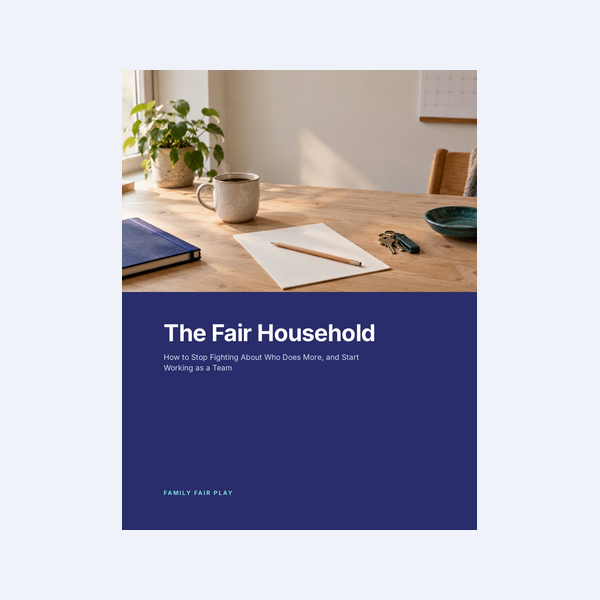
The Fair Household is a practical guide for couples who are both tired and done arguing. 12 chapters, 12 exercises and a 30-day plan you can follow without the app.

Instant PDF download. Every book comes with a code for 3 months of Premium.

See the book – €49.99
helpFAQ & Support

Frequently asked questions

Everything you need to know about how the platform works. Search or filter by topic.

support_agent
Didn't find your answer?
We usually reply within 24 h

Write to us and we'll gladly help with anything.

mailContact support
search
01How do stars work?
expand_more

Stars are a virtual currency that parents award for completed tasks. You decide their value and the rewards yourself in your household settings.

02Is my child safe?
expand_more

Yes. Your data is isolated and sensitive settings are protected by a parental PIN.

03What is mental load and how do you measure it?
expand_more

Mental load is the invisible work — planning, reminding, coordinating. FFP scores it by each task's difficulty, criticality and how replaceable it is, and counts it into the fairness index — not just the time spent doing chores.

04What if my partner won't use the app?
expand_more

Start on your own — you enter the tasks and the load once, and the Fairness Index shows the real split. It works best when your partner looks too, which is why the page has a section written for them and a live demo with no sign-up. They don't have to set anything up; looking is enough.

05What's free and what's Premium?
expand_more

Free gives you 4 members, 20 tasks and kiosk mode forever. Premium (from €1.99/mo) unlocks unlimited members and tasks, analytics, exports and notifications — one price for the whole household, not per person.

06How do I cancel my subscription?
expand_more

Anytime in the app: Settings → Premium → Manage subscription (Stripe portal). Your plan runs until the end of the paid period and is not charged again. The lifetime licence never renews — you pay once.

07How do I delete my account and all data?
expand_more

Right in the app: Settings → Privacy & data → Delete household. Deletion is immediate and irreversible — it removes data and member accounts and cancels any active subscription (GDPR Art. 17). You can download a data export first.

08How do kids use the app?
expand_more

Through kiosk mode on a tablet or phone: a child picks their avatar, ticks off a finished task and sees their stars right away. Their own PIN protects their profile, and a parent PIN protects settings and analytics.

09How do I use the app? Is there a manual?
expand_more

You won't need to look for one — the app has its own built-in guide on every screen, walking you step by step through what it does and how to use it.

10How do I install the app on my phone?
expand_more

Family Fair Play isn't in the app stores — it's a web app you add to your home screen straight from the browser. On iPhone in Safari via Share → Add to Home Screen; on Android in Chrome via Install app. On iPhone this is also required for notifications to work. See the article "How to add the app to your phone's home screen" for the full steps.

11Can I try the app without signing up?
expand_more

Yes. Click “Live demo” to open a fully-loaded sample household instantly — no email or password needed. It's read-only, so you can look around freely without breaking anything. When you're ready to make changes, create your own household: it starts pre-filled too, so there's nothing tedious to set up.

12Won't the app just tell me I was right all along?
expand_more

No. It measures both sides — physical time and mental load — and it often shows exactly what you weren't expecting. It isn't a judge. It's a mirror for both of you.

13Is this a chore app or a chore chart?
expand_more

Both, and neither on its own. It works as a shared chore app for couples and families — tasks, who does what, a chore tracker for the kids with stars. What a printable chore chart cannot do is weigh the tasks. We score each one for time, mental load, how critical it is and how easily someone else could take it over, so ten ticks each stops looking like a fair split once one person is doing all the planning.

14Can two adults split the chores here, or is it only for kids?
expand_more

Adults first. Each household member gets a load profile — physical minutes and mental load side by side — and the fairness index is worked out across everyone, not only the children. The kids' stars sit on top of that; they are not the point of the app.

15How do I get my partner into the app?
expand_more

You send them a link — by message, WhatsApp or in person. They choose their own password; you don't make one up for them. The link is valid for 14 days and their member card shows whether they've opened it.

16What is the Double Estimate?
expand_more

You both independently estimate how much of each area you do. The total almost always goes over 100 % — and that's normal, everyone remembers their own work best. That gap is the start of a conversation, not evidence against anyone.

17Do I have to buy another AI for this?
expand_more

No. Controlling the app with an AI agent is part of Premium and runs on the open WebMCP standard — you connect the AI you already use. No second subscription, and your family data doesn't go to another company; it stays between your account and your own AI.

18Do you have video tutorials?
expand_more

Yes — short video tutorials for everyday steps (adding a household member, generating tasks with the wizard, adding a task via an AI agent) are on the Tutorials page, linked from the site footer.

Nothing found
Try a different word or topic.

Transparency first

Your data isn't the product. Your household's data is isolated from everyone else's, sensitive settings are protected by a parent PIN, and you can delete your account and all its data yourself at any time.

Full Terms of Usearrow_forward

Articles and tips

Get inspired by advice for a harmonious home and a fair share of the work.

Stop tugging over feelings. Look at one number together.

One page you both see — and nobody has to win. Start for free, no card.

Start for free