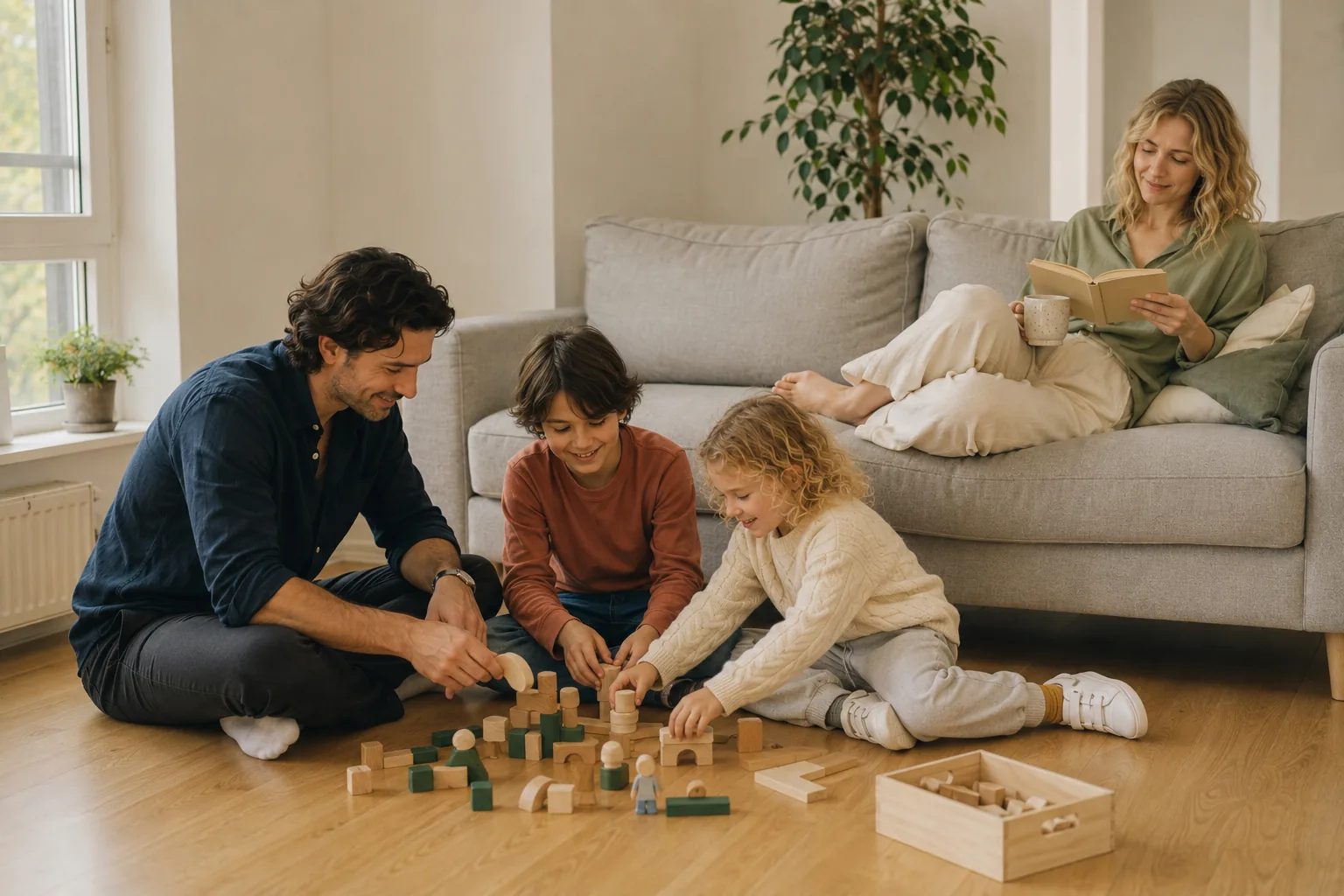
Sunday afternoon. There's finally a moment of quiet, so you sit down with a coffee and open the book you've been reading a page at a time for three weeks. You manage a paragraph and a half. Then, from around the corner: "Where's the charger?" You answer. Another paragraph. "Mum, Dad – are we still going out today?" You answer again. And somewhere between the third and fourth question you quietly close the book. Not because you don't want to read. Because there's no longer any point.
This is called interrupted rest – and it's a sneaky thing, because on the surface it looks like time off. After all, you "sat down with a book". In reality you were on standby the whole time, one ear open, ready to get up at any second. And your body and your mind know exactly that between that and real rest there's a chasm.
Rest that can be interrupted at any moment isn't rest. It's waiting for the next task, lying down.
Why rest isn't a reward
In many households a quiet assumption lives on: work first, rest after. I'm allowed to rest once everything is done. It sounds responsible. The problem is that in a family nothing is ever done. There's always one more thing – finish wiping the counter, get things ready for tomorrow, reply to the message from school. If we wait for the work to end, rest never comes.
So "I'll rest once I've finished it" in practice means "I won't rest". And one of the two spends years in a mode where time off must first be earned – and because it's never fully earned, every break comes with a quiet sense of guilt. That isn't rest. It's just work with a pause, during which the person feels bad.
What real rest actually needs
For a break to genuinely recharge the batteries, sitting down isn't enough. It needs three things that interrupted rest never has:
What real rest is made of
Uninterrupted: A continuous block of time with no questions and no interruptions – not five minutes between two tasks.
Handing over the watch: Someone else holds the responsibility during that time, so the mind is truly allowed to switch off.
Without guilt: Knowing this time is mine by right, not as an exception I have to apologise for.
Notice that it's mostly about the mind. Anyone can physically sit down. The hard part is to stop mentally tracking what's happening in the next room, when something needs preparing, whether anyone needs anything. That quiet background watch is the mental load – and while it's running, no rest happens, even if you're lying down.
When one person's rest sits on the other's shoulders
Here's a subtle catch that families rarely say out loud. For one person to truly rest uninterrupted, someone else has to take over the whole watch during that time – the children, the home, all the "where's the...". If that doesn't happen fairly, you end up with one person who always gets their uninterrupted time off and another who almost never does. And that other person often doesn't even complain – they just gradually stop having any time of their own at all.
It isn't ill will. Most of the time neither of the two even notices, because interrupted rest is invisible – nowhere does it get recorded that one of you put the book down three times today. That's why goodwill alone can't fix it. It can only be fixed by finally seeing it.
How Family Fair Play makes rest part of the plan
This is exactly where it helps to have the household's load made visible. Family Fair Play shows, on the fairness index, how much of the total work – including the invisible, mental kind – each family member actually carries today. And if one person carries far more over time, that isn't an accusation but a clear signal: this person needs uninterrupted time for themselves, and not as a reward but as a rebalancing.
When the load is on the table as a shared map, rest stops being something you have to secretly wrangle for yourself. It becomes part of the plan – "on Saturday morning you've got two hours just for yourself, I'll take the kids and the house" sounds completely different from "if I get the chance, maybe I'll sit down". The first is an agreement both of you can see and protect. The second is a hope that almost never comes true.
And when someone genuinely needs to step out of the usual routine – exhaustion, illness, a demanding stretch – the app also has a pause mode: a member is temporarily marked inactive, their tasks aren't counted against them in the meantime, and the family can see that this rest is legitimate right now, not an escape from responsibility.
Rest as a need, not an exception
Try naming it out loud at home for once – not "if I get the chance", but "I need an hour without interruption, and I want you to hold the fort during it". And then give the other person exactly the same. Not as a favour to be repaid, but as something obvious that everyone on the team is entitled to.
Because a rested person isn't a luxury for the family – it's the best thing that can happen to it. A more patient parent, a more present partner, someone who isn't giving from empty. And sitting down isn't enough for that. It takes a right to uninterrupted, clean, unburdened time.
Time off isn't a reward for finished work. The work never ends. Rest is a need – and the fairest home is the one where everyone has an equal right to it.