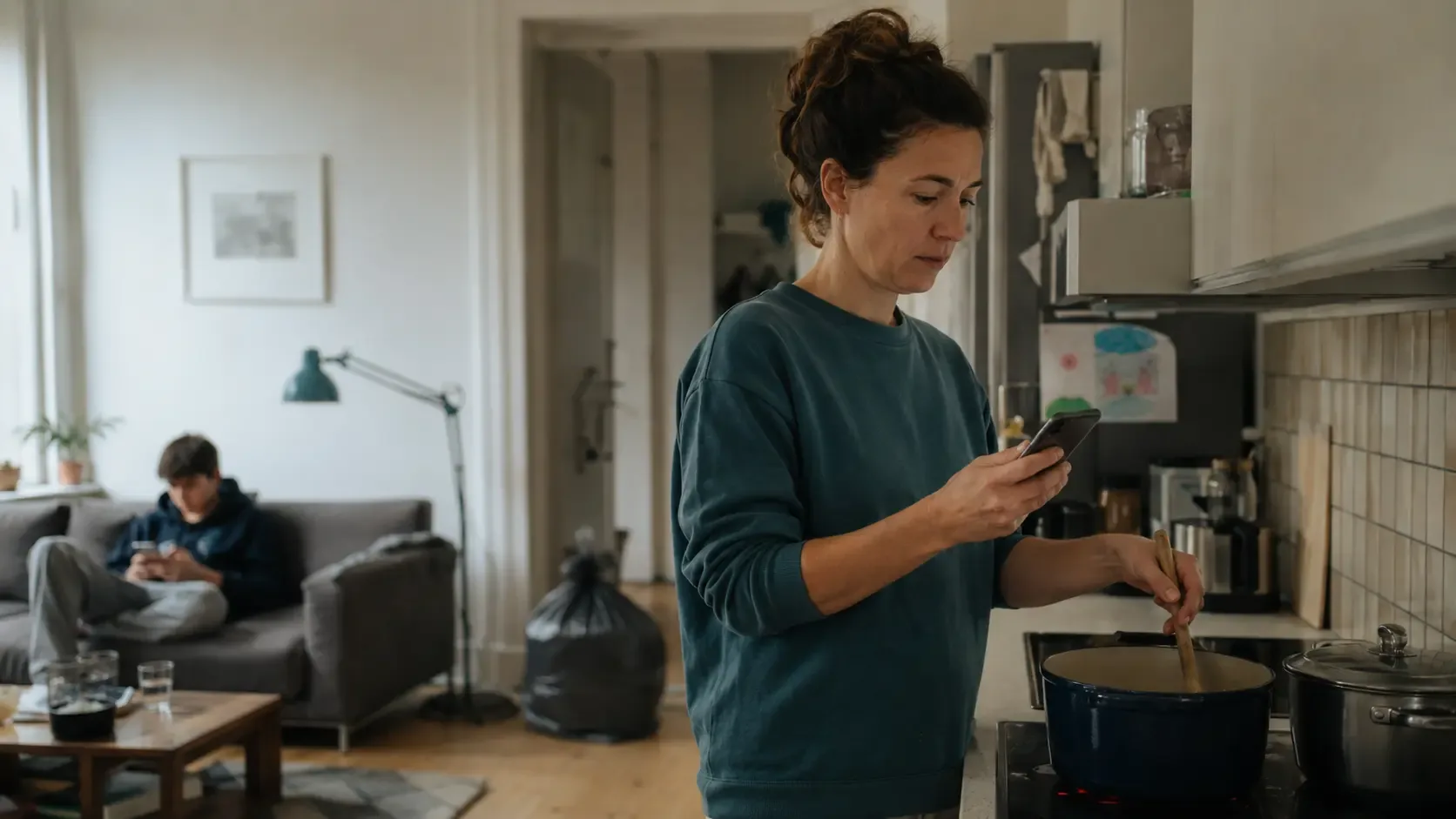
Saturday morning, 9:15. The kitchen is post-breakfast chaos. You're standing at the hob, phone with the shopping list in one hand, wooden spoon in the other. The washing machine has just beeped – the laundry needs moving over, but first someone has to nip out for milk, because there won't be enough for lunch. "Can you take the bins out?" you call down the hallway to your fifteen-year-old son. Silence. Then: "Later." The music in his headphones gets a little louder.
In the end you take the bins out yourself. Brow furrowed, quietly resolving that you'll definitely have a word about it over lunch. Over lunch it somehow gets forgotten, because it's so much easier not to start a row. By evening you're collapsing into bed feeling like the only person in the whole flat who can see what's going on.
Sound familiar? And do you remember what you were like as a teenager?
The guest mentality: why kids genuinely don't see it
Here's the uncomfortable truth: your child probably isn't sabotaging you. They simply don't see what you see.
Think back to your teenage self. You too lived under the illusion that things just happened by themselves. Lunch cooked itself. Clean clothes landed in the wardrobe by some mysterious force. The fridge restocked itself without any effort from anyone. That's the so-called guest mentality – the state of living in a space without feeling like one of its keepers.
Children learn what they see. And if running the household is invisible to them – if they've never seen the full picture of everything that keeps it going – they can't take responsibility for something they don't know exists. They're not lazy. They're simply untrained.
The responsibility gap, and why "help me when I ask" doesn't work
Psychologists describe something called the responsibility gap. It appears when a child only ever performs individual actions on request – but has never taken ownership of a whole task. Taking the bins out once a week when a parent asks is not the same thing as being responsible for the bins always being out on the right day.
The difference is fundamental. In the first case the child is a helper. In the second, a teammate. And it's precisely that shift – from doing to owning – that shapes a responsible adult.
Requests, deals and "when I ask you" on their own aren't enough, because they push the responsibility for remembering straight back onto the parent. The system only holds as long as the parent actively props it up. If the parent forgets to remind, the task doesn't happen. And the cycle of frustration rolls on.
Three levels of involvement
Helper: Does what you tell them. Never starts on their own and doesn't notice when something slips.
Contributor: Knows what their jobs are. Sometimes takes the initiative, sometimes doesn't.
Teammate: Owns their role. Senses when something's off and acts without being reminded.
Age-appropriateness: not everyone can do everything
The second pitfall is unrealistic expectations. A four-year-old can't carry the same responsibility as a fifteen-year-old. When parents hand out tasks with no regard for age and ability, two opposite problems appear: younger children get overwhelmed and lose motivation, while older ones get bored with trivial jobs and stop taking their duties seriously.
Research in developmental psychology shows that children who are given appropriate challenges – not too easy, not too hard – develop a stronger sense of self-worth and competence. The key word is appropriate.
A toddler (2–4) can manage carrying their own plate to the sink. A preschooler (5–7) can help sort the laundry by colour. A school-age child (8–12) can be in charge of, say, looking after a pet or laying the table. A teenager (13+) can genuinely own recurring tasks – buying the milk, wiping down the bathroom, keeping an eye on supplies.
A system everyone can see – kids included
The solution isn't pressure, punishment or endless reminding. The solution is visibility. When every member of the family has a clear overview in front of them – who does what, what's expected and how it contributes to the whole – the entire dynamic changes.
Family Fair Play was designed with exactly this in mind. The app lets you assign tasks to every member of the household, children included – across six age categories, from toddler to adult. Every task has a clear owner. Not "give me a hand when you get a minute", but "this is your task, and you're responsible for it".
The app's kiosk mode is built so that even children can use it. A simple interface, a view of their own tasks, instant feedback. The child marks a task as done themselves – and sees the result straight away.
Stars aren't a bribe. They're recognition of work done.
Many parents worry that rewarding chores sends the wrong message: "So you only do things for money?" But the research tells a different story. The problem isn't the reward itself – it's reward without responsibility. When a child earns a reward for completing a specific task they truly own, pride and recognition come bundled together.
In Family Fair Play, the star economy works simply: every completed and approved task earns stars. Parents can set up a reward catalogue – from extra screen time to a family day out. The child collects stars and decides for themselves what to spend them on. No haggling, no whining. The system is transparent for everyone.
Most importantly: a child only earns stars for tasks a parent has approved. So the parent stays in control of what gets valued – without having to play household police officer every minute of the day.
What a household with kids as teammates looks like
Picture that Saturday morning again. This time your son knows what's his. The bins – that's his job, every Friday evening. Not because you asked him. Because it's his thing, and he can see on the tablet that it's waiting to be marked as done. He marks it. He gets his stars. You don't have to lift a finger.
The sound of someone else carrying out the bins without you having to open your mouth is one of the small miracles of modern family life.
But the long-term impact is even bigger. Children who grow up with a clear role in the household step into adulthood with something precious: the ability to see what needs doing and to do it without being asked. That is no small thing. It's the foundation of self-discipline – and of empathy in their future relationships.
A household isn't a place where children merely live. It's where they learn to be part of something bigger than themselves.