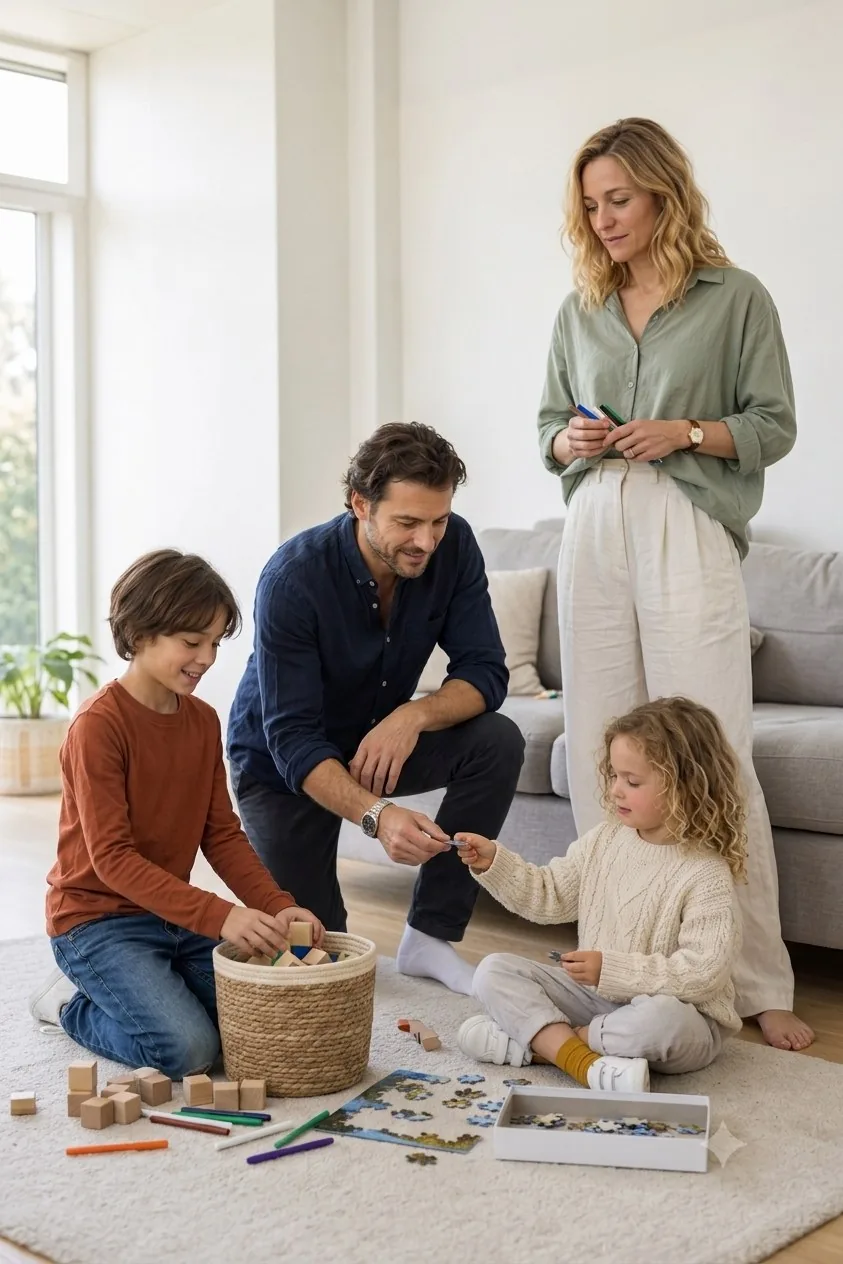
Wednesday, 5:40pm. The living room looks like the aftermath of a small earthquake: building blocks under the table, felt-tip pens missing their caps, a half-finished puzzle right in the middle of the rug. "Could you tidy this up please, dinner's nearly ready." Ten minutes later, nothing has changed. "Are you tidying up?" Silence. By the third time, the sentence no longer sounds like a request but like a warning – and five minutes after that you're picking up the toys yourself anyway, because it's quicker and dinner is going cold. On the way to the kitchen you say to yourself the sentence parents all over the world are saying that very same evening: "Do I really have to beg for everything?"
If this sounds familiar, you are not a bad parent. You don't want to be the one who spends the whole evening telling people off – and yet, evening after evening, you become exactly that, because there seems to be no other way. And the other side of it is true as well: your child is not lazy or spiteful. From their point of view, chores appear out of nowhere, in the middle of a game, like orders from above – with no context, no beginning and no end. They don't see a system they belong to. They only see that someone has interrupted them yet again.
The evening battles over toys are not a contest of wills between parent and child. They are a signal that the child keeps receiving orders – but has never been given responsibility.
Why reminders don't work (and guilt trips even less)
Every household task has three phases: noticing (someone has to spot that the toys are all over the room), deciding (when it gets tidied, where things belong, what counts as "done") and doing (the actual picking up). When we issue a command every single time, we leave the child only the third one – doing on demand. Noticing and deciding stay in the parent's head. And the child learns precisely what we are showing them: there's no need to notice anything, no need to decide anything, just wait until the parent's voice reaches a certain level of urgency. Reminding doesn't build responsibility – it builds waiting for the third repetition.
Guilt trips go a step further still. "I had to do it for you again" doesn't tell a child what to do differently next time – it only tells them they've been a disappointment. In their mind, the task gets wired to bad moods and shame, and it's no surprise they start avoiding it even more. The motivation is no longer "this is my job and I want it done", but "I don't want them to be upset". The first grows with a child for their whole life. The second vanishes the moment the parent leaves the room.
Responsibility is not obedience
We often confuse the two, because from the outside they look identical: the room ends up tidy. The difference lies in what happens inside the child's head. Obedience means carrying out an instruction – and it ends exactly where the supervision ends. Responsibility means "this task is mine, even when nobody is watching". It can't be forced and it can't be begged for. It can only be handed over – the way anything precious is handed over: whole, visibly, and with trust.
Obedience vs. responsibility
Obedience: "Do it because I said so." The child waits for the command – and for the inspection.
Responsibility: "This task is yours – from noticing it to finishing it." The child knows what's theirs and needs no command.
The difference: The first ends when you leave the room. The second a child carries into adulthood.
How to hand over a task so a child truly takes it on
First: hand over the whole task, not fragments of it. "Pass me those blocks" isn't responsibility, it's assistance. "From today, the toys in the living room are your kingdom – you decide where they live, and you put them away in the evening" is something else entirely. The task has to fit the age: a six-year-old can manage a toy basket, a ten-year-old can easily own their whole desk and their school bag for the next day. What matters is that the child holds all three phases – noticing, deciding and doing – within a small, age-appropriate world of their own.
Second: the task has to live somewhere other than in your voice. As long as the list of chores exists only in a parent's head, the only way it can reach the child is through reminders – and we're back where we started. Families who get this right have a shared map of the household: an agreed, written overview of who looks after what. It doesn't have to be anything sophisticated – a sheet of paper on the fridge will do. What matters is that the task is brought to the child's attention not by a parent, but by a system everyone can see equally. "Have you tidied up?" turns into "Have you checked your list?" – and that difference lifts the role of eternal enforcer off the parent's shoulders.
Third: give the task a frame, not a "right now". An order issued mid-game will lose every time – not because the child is disobedient, but because from where they stand it feels unfair. "The toys are picked up by dinner" leaves the child something adults take for granted: the freedom to decide when. It's precisely that small freedom that turns a duty into ownership.
Fourth: replace the guilt trip with a consequence and with recognition. When the task isn't done, no lecture is needed – just a calm consequence agreed in advance: the puzzle left on the rug goes up on the shelf and waits until tomorrow. And when it is done, let the child live that moment: "I noticed you did that completely on your own today." Not a reward for performance, but recognition that they could be relied on. It is exactly these moments that build the kind of confidence no praise for obedience ever will.
An evening without the third repetition
It won't happen over a weekend. In the first days the toys will be picked up later, differently and less thoroughly than you would have done it – and that is exactly where everything is decided: whoever "fixes" the task after the child takes it back from them. But after a few weeks there comes an evening when you catch yourself not having had to say anything. The child walks through their room before dinner because they know what's theirs – and mentions it at the table with pride, not with relief at having dodged a telling-off.
Children don't learn responsibility from our words, but from what we genuinely entrust to them. Every task we hand over whole – with trust, visibly and without reproach – is a small lesson that a household is not a hotel with room service, but a team where everyone has their place. Even the smallest member.