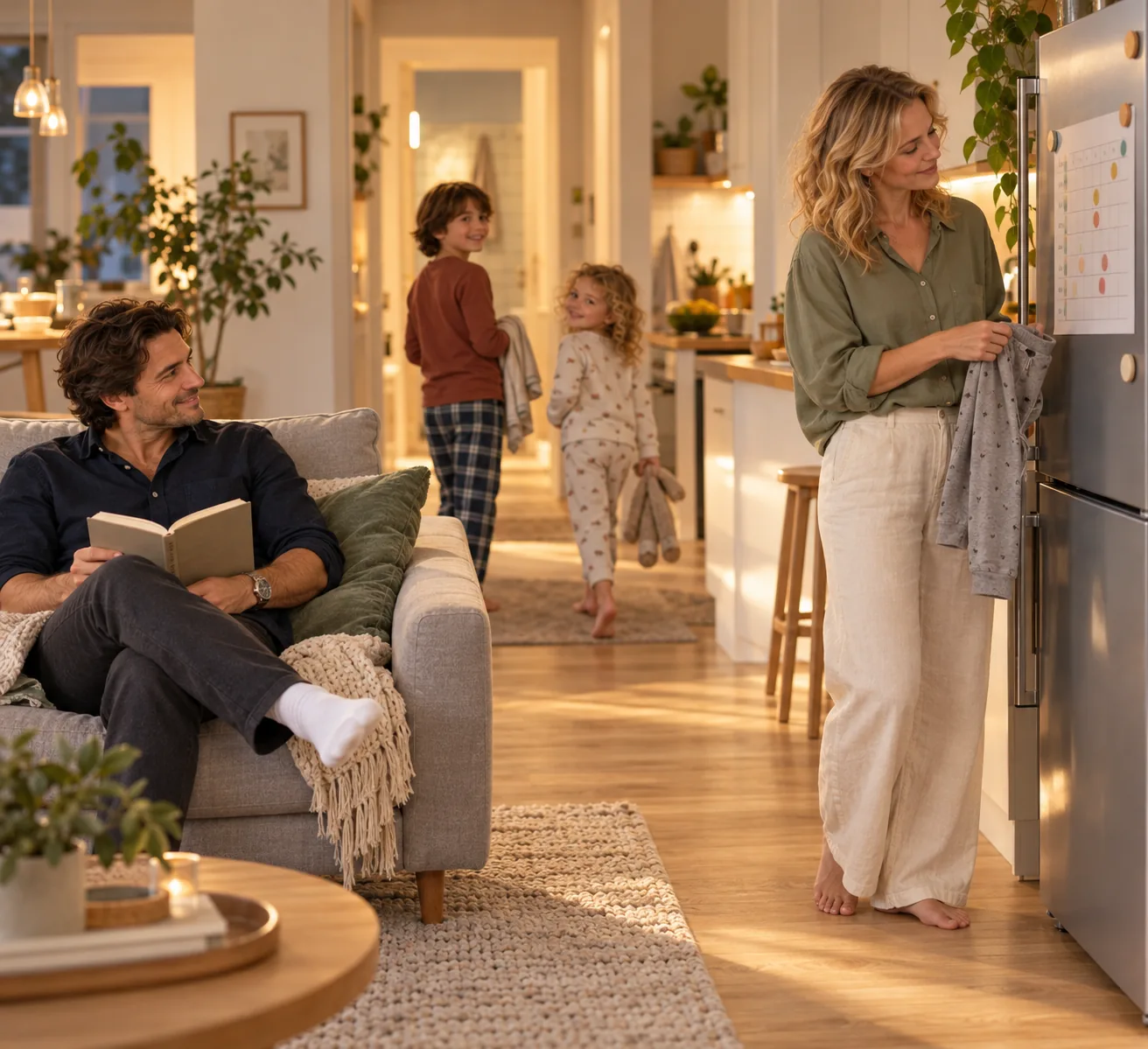
It is Thursday evening at Zuzka and Rado's, and it goes like this. The kids are in the bathroom, and Jake calls out that he needs sweatpants for gym tomorrow, because today's are in the wash. Zuzka glances at the weekly plan on the fridge door, where laundry has her name beside it, and says, "I'll put them in the dryer." Rado is finishing his book. Nobody asks who has it. Nobody reminds anybody.
The family in this article is illustrative, not a real case. It is what an ordinary year of small steps can look like in any household.
What it looked like a year ago
A year ago, that same sentence would have gone differently. Jake would have mentioned the sweatpants, and Rado would have known long before where they were, when the washer would finish, and what could be worn instead. Zuzka would have heard it as background noise. Not because she did not care, but because she had never had a reason to learn it. Rado knew. That was how it had worked for years.
You know the result. Rado was tired in the evenings from things nobody would call work, and Zuzka felt unappreciated for things she did that nobody mentioned. They were both right and both worn out. From that evening to this Thursday ran five steps.
Step one: make it visible
The beginning was not dividing. For the first two weeks, each of them wrote down what they actually do, not only what can be seen but also what they have to carry in their head. They did not show each other until it was done. Only then did they compare. One list had fifty items, the other thirty, and the overlap was surprisingly small. It was not about who won. For the first time, they saw the whole house on one piece of paper.
Step two: look at the three phases
For every bigger task they wrote down who notices it, who decides about it, and who does it. They found that Zuzka did a lot but started almost none of it. Rado noticed and decided, and then often did it too, because that was quicker than explaining. The invisible part of the work kept flowing toward one person, and nobody had ever decided that.
Step three: hand over whole tasks
Instead of a promise to "help more," they divided the tasks so that one person held each one from start to finish. Zuzka took laundry and school matters. Rado took doctors and vacations. The deal had one rule: whoever takes a task owns it, and nobody else talks about it or reminds them. The first weeks were shaky. The sweatpants were forgotten once, and the school coped. Nothing happened.
Step four: give it a permanent place
A list on paper tends to vanish under the shopping lists after a month. So they moved theirs into Family Fair Play, where they keep the tasks, who plans each one and who does it, and for every member their physical and mental load on their own card. Monthly and seasonal tasks have a date and an owner, so they show up when needed. More important, every Sunday they take twenty minutes. They look at the coming week, say what was hard, and take away one agreement. The app holds the data, but the conversation has to be held by people.
Step five: plan for dropouts
In month six, Zuzka was ill for a week. Nobody panicked: the plan B page had been written in advance, the kids knew what they were doing, and Rado knew which three things had to keep working and which could wait. In winter, the system still failed for two weeks. The holidays arrived, the meetings were skipped, and the list began to fall apart. They did not start over. They made one restart: one meeting, one agreement.
What did not change
The amount of work did not shrink. The house still gets dirty and the kids still need sweatpants. There is no year in which nobody gets annoyed. What changed is what the arguments are about: instead of "you never notice anything," a dispute is about one specific thing that can be fixed.
The biggest difference is not in what gets done but in where it is kept. A year ago, the house lived in one head. Today it hangs on the fridge door.