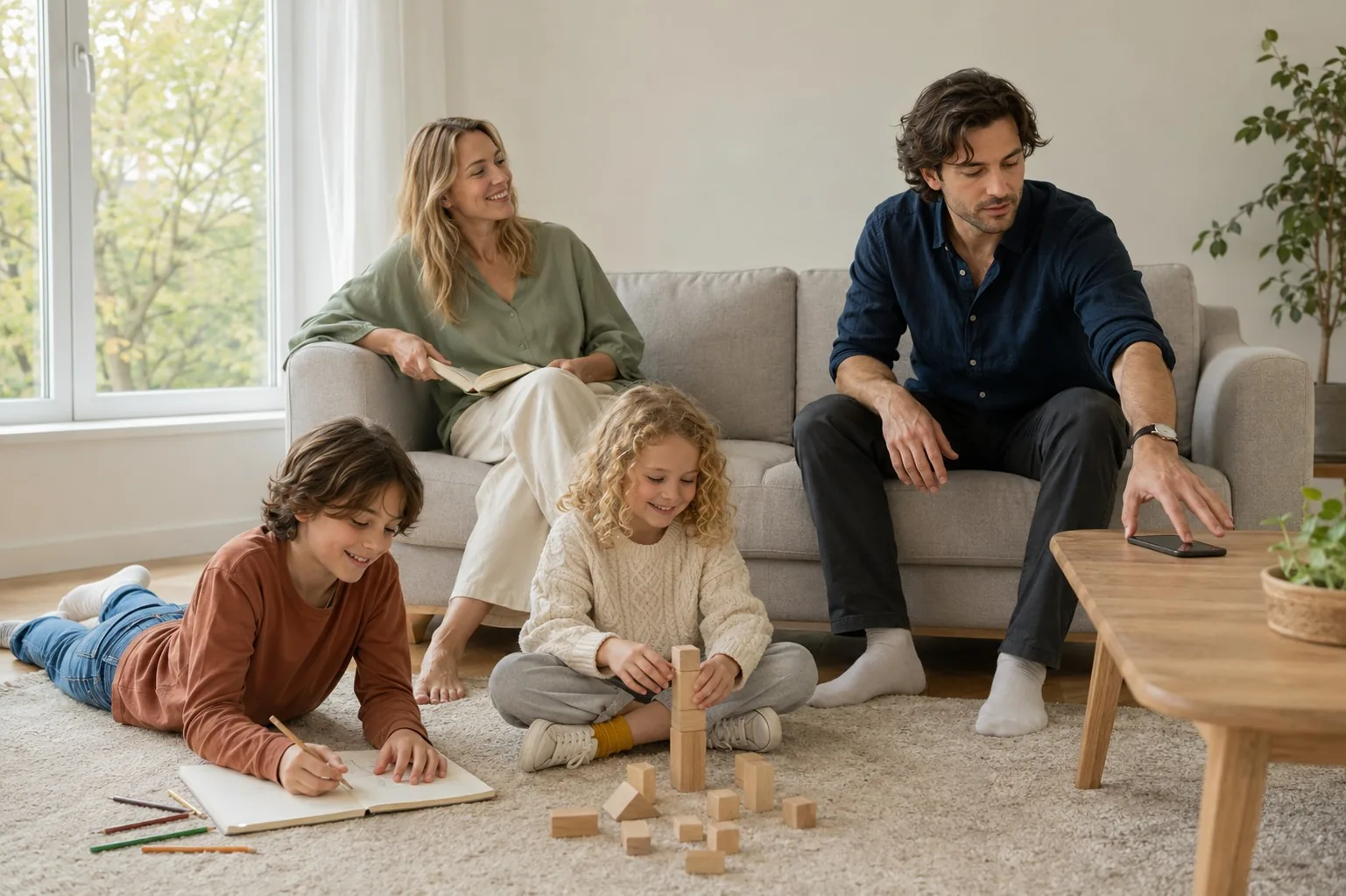
It's Saturday, three in the afternoon. The dishes are done, the shopping is put away, the kids are playing nearby, and your partner has just finished the paper at the table. Nobody needs anything from you. On paper, this is exactly what you spent months working toward – a free hour that genuinely belongs to you. Instead of sitting down and letting it pass, you reach for your phone and scroll through three apps. Or you get up and start sorting a drawer nobody asked you to sort. The hour goes by – and you can't really say what you did with it.
This isn't a sign that you don't want to rest. It's a sign that for years you operated in a mode where a free moment meant one thing only: room for the next task you hadn't noticed yet. A mind trained to constantly scan the surroundings – what needs buying, what's coming up, who hasn't been forgotten – doesn't switch off just because the household is finally split fairly. Habit beats the schedule.
Free time that appears because of a fairer system isn't automatically rest. You have to relearn it.
Why empty time feels like a problem
When the mental load finally drops, most people expect relief. Something else shows up too – a mild unease that's hard to name. An empty stretch of time with no clear task feels suspicious, as if it's hiding something you're forgetting. So we fill it instinctively – with anything that resembles work, or at least with a phone, which at least looks like activity. Not because we don't deserve rest. Because for a long time we learned to equate stillness with neglecting something.
Where the unease comes from
Whoever spent years holding the household's whole operation in their head – thinking of tomorrow before thinking of themselves – built a kind of quiet vigilance. It isn't a bad habit; it's a learned strategy that worked for a long time. The problem is that it doesn't switch off on command. Even once the system genuinely redistributes the load, the mind keeps asking the same question for a while: "What am I forgetting right now?" And because the answer is usually "nothing", free time ends up feeling oddly untrustworthy.
How to tell the time is really yours
It has no deadline: No item from the list is waiting for it, not even the one you're "fitting in meanwhile".
Someone else is holding the watch: Awareness of what's happening at home sits with someone else right now – genuinely, not just on paper.
You're allowed to keep it for yourself: Even if nothing gets produced, tidied, or ticked off.
How Family Fair Play makes time visible
Part of why free time is hard to trust is that it's invisible – nowhere does it show that this week's load genuinely dropped rather than it just being a lucky fluke. The timeline in the analytics view (the last eight weeks of completed tasks) fixes exactly that: it shows whether the drop in load is a trend you can rely on, or a one-off exception. Once you see it in black and white, you stop unconsciously waiting for that free hour to be reclaimed by something else.
The fairness index helps the same way – it shows that your free time didn't appear at the other person's expense, but because the load really is split evenly. That's the difference between "I'm enjoying this while someone else covers for me" and "we both get our share of rest, because we both carry our share of the work." Only the first one comes with guilt attached.
And when you sit down together at the weekly family meeting over those same numbers, it's worth adding one more question – not just "who does what", but "what are we doing with the hour we freed up this week". Free time that someone deliberately plans for is far less likely to get lost in a phone.
What to actually do with that time
You don't need a big plan. Start by naming the time out loud – "this hour is free, I haven't scheduled anything for it" – and then notice what you actually do when you don't have to do anything. Sometimes it's a walk with nowhere to go. Sometimes it's just sitting next to each other without talking about tomorrow. What matters is that the moment doesn't automatically turn into another task – and that the kids see it too. When children watch their parents genuinely sit still and do nothing, they learn that rest isn't something you have to earn, but an ordinary part of the week.
Time that a fairer household frees up isn't a reward for work well done. It's space you have to relearn how to enjoy – together, without the feeling that something is being neglected in the meantime.