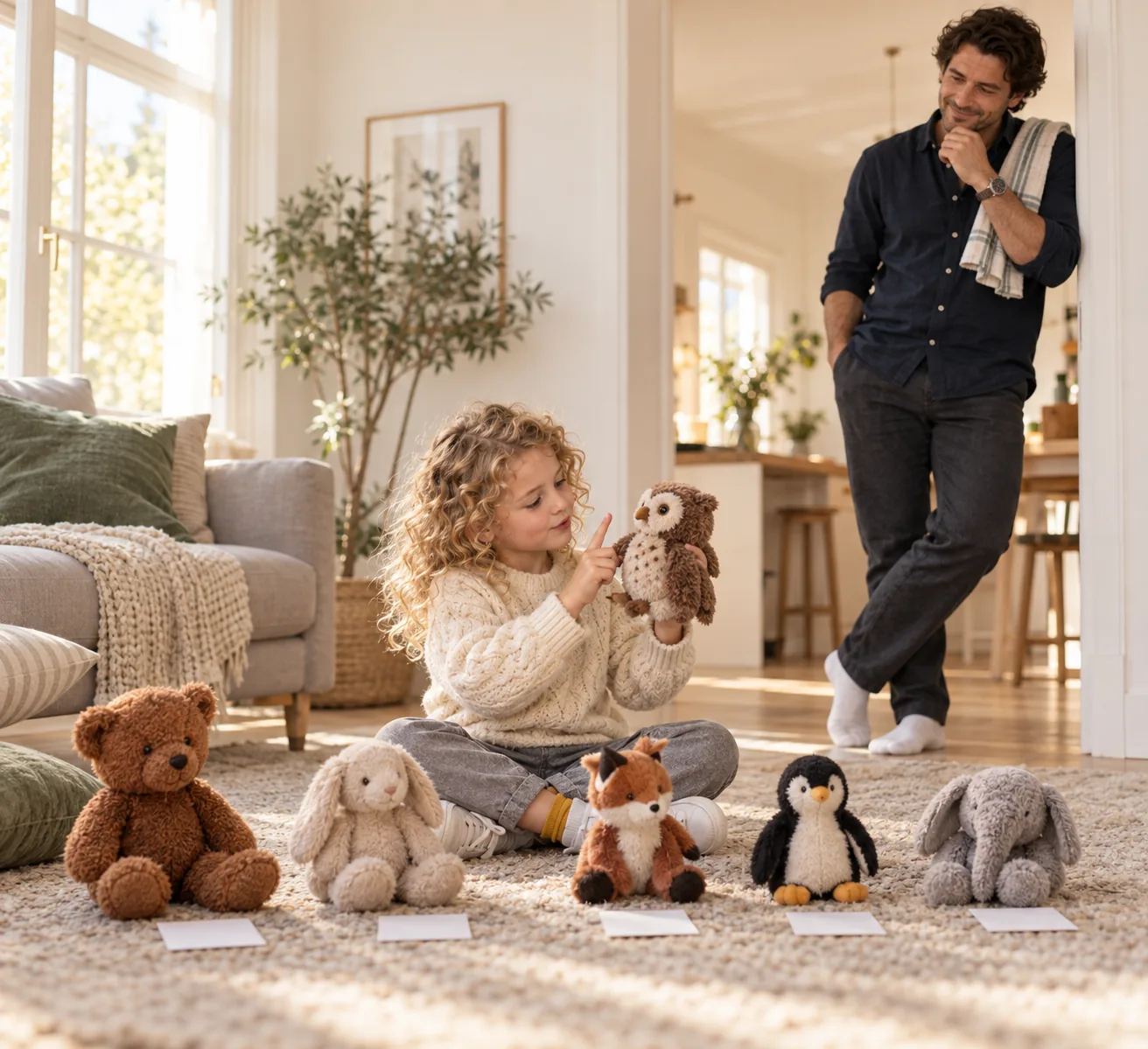
On a Sunday afternoon, seven-year-old Ema sits on the rug dividing up the work among her stuffed animals. Each one gets a slip of paper, and she announces in her most serious voice: the bear takes out the trash every Tuesday, the rabbit cooks lunch, the turtle waters the plants. Then she picks up the owl. "And the owl remembers everything," she says. "The owl tells the others what to do."
A parent listening from the kitchen asks how the owl manages it. "Easy," Ema says without hesitating. "It looks at what needs doing and then tells everybody. Even when it's Tuesday."
Nothing in that game is made up. It is exactly how the world she sees every day works, moved onto a stuffed-animal company in a bedroom.
What a child picks up from the kitchen doorway
In a series of experiments in the 1960s, the psychologist Albert Bandura showed that children imitate the behavior of adults they watch, even when no one tells them to. You do not need to turn that into a law about who a child will become. It is enough to notice that children learn from what is never explained to them.
At home, a child sees four things, and files each one away as normal.
Who notices that something needs doing. A child does not only see who cooks. They also see who knows the flour has run out, who remembers the dentist appointment, who gets asked "where is my bag?" and who answers. If it is always the same adult, the child learns that remembering belongs to one person. They see the finished result, but the invisible work behind it stays invisible to them too.
Whether work is done openly or quietly. A child who never hears "I'm writing down that Sam needs new sneakers" has no way of learning that planning exists. They see the finished thing, not the road to it.
What happens when an adult is tired. Can it be said out loud, or does a tired adult go quiet and shut the door? From that, a child works out whether tiredness is allowed to have a name and whether help can be asked for after it.
How adults settle things. A fight at the dishwasher teaches them that a dispute about work is a contest to be won. A calm "I'll take this one" teaches them something else.
An honest limit
How your children will split work in their own homes twenty years from now, nobody can tell you in advance, and promising it would be dishonest. A long road with many other influences lies between what a child sees and what they do as an adult: friends, partners, school, temperament. All we can say is that a child is always learning, and that the picture you give them is one of the most frequent ones they have.
You don't need lectures
The good news is that none of this needs preaching. Children respond badly to explanations and well to example. Four small things help.
Say out loud what you are doing in your head. "I'm checking whether we are home next week, because I need to book the doctor." One sentence turns planning into something a child can see. A child who hears it discovers what they could not see before: that every task has three phases, noticing, deciding and doing, and usually only the last one is visible.
Give a child the whole task, not just the end of it. Not "help me with the plants," but "the plants are yours: you know when they need water, and you water them." A sense of owning a task can only be learned from a task that is truly yours.
Let them see how you settle things. Not every argument, but the repair after it. "I said that sharply earlier, and I'm sorry. Let's split it a different way." A child learns that agreement is a skill and not a law of nature.
Keep rest visible. An adult who says "I'm taking an hour for myself" and is not interrupted shows that rest is not laziness. A child who sees a parent who never sits down learns that resting is suspicious.
What the owl takes away
A week later, Ema is updating her company. She has put a date on every slip, and the owl now has a helper: a rabbit who remembers Tuesday on its own. "So the owl doesn't have to do everything," she explains. Nobody suggested it. She saw at home that it can be done that way.