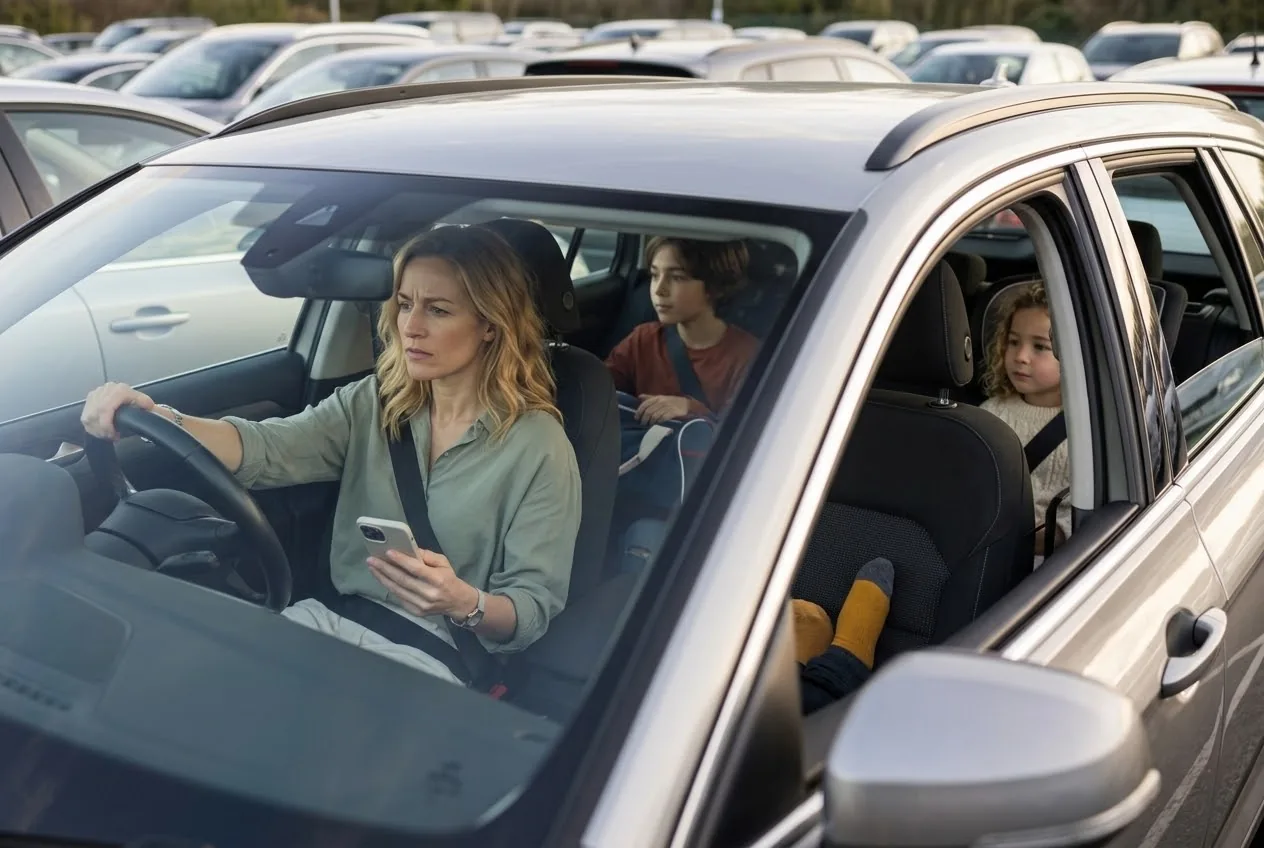
“Can you take them to the away match on Saturday?”
“Sure. Where is it?”
“…”
“All right, send me the address.”
That last line sounds like taking the job on. In fact it takes on the end of it. “Send me the address” means: you work out where exactly we are going, whether it is the sports centre or the pitch behind it, where the parking is, how far the walk is from there, what time we therefore have to leave, what the children need to bring, and what we do if the car park is full. Once you have thought all that through, I will drive.
Driving is not the hardest part of driving. The demanding part happens beforehand, runs entirely inside someone’s head, and leaves nothing behind that anyone can point at.
Which is exactly why it never comes up at home. The car is visible. The miles are visible. Getting back at half six is visible. The hour someone spent the evening before on a map, a satellite view and the organiser’s website is visible to nobody, including the person who spent it.
The decisions made before the engine ever starts
Take that invisible hour apart. It is not one activity. It is a run of decisions, each of which has to be made once and made properly, because on Saturday morning there will be no time to ask.
Seven things somebody has to know before leaving
1. Where exactly. Not the town. The building, the entrance, the floor, the pitch number.
2. How long it takes at that hour on that day, not on average.
3. Where to park and whether you can at all. Is it paid? By app? Is it residents only?
4. How far the walk is from the car. This is the single most underestimated item of the whole trip.
5. When to leave and therefore when to start rounding up children and kit.
6. What to bring. Membership card, boots, water, cash, charger, waterproofs.
7. What if it goes wrong. Where else you can park, who to ring, how late you can be.
Seven decisions, not one of which can be made at the wheel. All of them have to be finished first. And here is the heart of it: when two people “split” a journey so that one of them drives, they have not split it. They have split its final item.
An unfamiliar route is a different job
This is not an impression. A systematic review by Harms, Burdett and Charlton from 2021 went through 94 studies of how a driver’s behaviour changes with route familiarity. The conclusion is clear: on a familiar route the need for conscious control falls away and the mind can afford to wander. On an unfamiliar one it cannot, because route planning, information search and problem solving all keep running alongside the driving.
A 2022 study at nine junctions in Changsha, China showed it in the eyes. Twenty-four drivers, half of whom knew the route and half of whom did not. Those who did not showed longer processing times and higher mental workload. Those who did had attention to spare: they checked their rear-view mirrors 42.9% more often.
Translated into household terms: the same distance is not the same task. Twenty miles along a route someone has driven for five years and twenty miles somewhere they have never been are two different jobs, even though the calendar shows them identically. The difference is not in the miles. It is in what had to be known in advance.
Parking is a separate job nobody counts
In 2006 the UCLA economist Donald Shoup pulled together measurements of the search for a parking space across studies running from 1927 to 2001. Finding a kerb space in a congested centre took between 3.5 and 14 minutes, and between 8% and 74% of the traffic around at the time was cruising for a space.
That range matters more than the numbers. It is not “add five minutes”. It is an interval you cannot land on, which means you have to budget for the worse end of it. Whoever plans a trip to an unfamiliar place is not deciding about five minutes. They are deciding how much uncertainty to accept, and what to sacrifice from the morning to cover it.
That uncertainty is not free. Transport economics can even price it. The ratio comparing the value of a predictable arrival with the value of the travel time itself runs, across reviews of the estimates, from roughly 0.5 to 3.3, and for car trips it is most often put at around 0.8 to 1.3. Put plainly: a minute of not knowing when you will arrive is worth roughly as much to people as a minute of actual driving. Nobody logs it, because it does not happen on the road. It happens in the head of whoever prepared the journey.
Why it tires you out before you have gone anywhere
There are two mechanisms here, and both have been measured.
The first is the reserve. People systematically underestimate how long anything will take. The classic study by Buehler, Griffin and Ross in 1994 asked 37 students when they would finish their thesis. The average estimate was 33.9 days; the reality was 55.5; and only about 30% met the deadline they had set themselves. So building slack into a journey is not a personality trait. It is a deliberate correction of your own estimate, made against your instinct, by somebody, on purpose. That is a decision, not a habit.
The second is holding it in mind. Memory research calls this prospective memory: remembering that at ten past four something will need doing. A study by Rebekah Smith in 2003 showed something households never allow for: simply holding such an intention measurably slows down whatever you are doing in the meantime. The point is not that you might forget to leave. The point is that for the whole time you are remembering, you are working on two things at once.
Which answers the line “it’s nothing, we’re leaving at seven”. It is nothing if you are not the one holding it. If you are, you have been paying for it all afternoon.
Where exactly the job changes hands
In 1985 the Dutch psychologist John Michon described a model traffic psychology still uses: driving runs on three levels at once. The strategic level decides where you are going, by which route, when to leave and what will still fit in. Crucially, it also runs before the drive, on a scale of minutes to hours. The tactical level overtakes and turns. The operational level holds the lane.
“Sure, send me the address” takes over the second and third levels. The first stays exactly where it was. It is the same dividing line every household job has: three phases, noticing, deciding and doing. A car journey simply draws it unusually sharply: the first phase physically happens somewhere else, on a different day, from the second and third.
In her 2019 study of the cognitive side of household labour, the sociologist Allison Daminger broke this thinking layer into four parts: anticipating a need, identifying the options, deciding, and monitoring. Preparing a journey contains all four in pure form. Daminger also found that this layer fell to one and the same person in 26 of the 32 couples she studied, most strongly in the anticipating and the monitoring.
On top of that sits a responsibility most chores do not carry. If the plan is wrong, there is nobody to hand it to at half four on a dual carriageway. And the driver alone answers for the children in the car: under UK seat belt law the driver must make sure each child is in the correct seat until they are 135 centimetres tall or twelve years old, with a fine of up to £500 if a passenger under 14 is not. Planning and driving are both single points of failure, and that is unusual for housework.
Five practical conclusions
1. Split journeys by whether anyone has been there before. A first trip to a new place and a fifth trip to the same one are not the same task. Whoever goes first is doing reconnaissance as well as driving. If you alternate, alternate the first ones too, not just the familiar ones.
2. Reconnaissance is done once, so put it somewhere. The address, where to park, how far the walk, which entrance. While it lives only in one person’s head, every future trip needs that person again, even when somebody else is driving. Write it down once where the other person will find it: on the shared calendar entry, or in a shared note on the phone. Five minutes there saves that hour on the map every single time.
3. Don’t ask for the address, ask for the decisions. The gap between “send me the address” and “I’ll work the whole thing out and tell you when we leave” is this entire job. If you are taking the journey on, take the reconnaissance with it. If you have not got time for that, say so plainly, so at least it does not look like taking on the whole task.
4. Agree the reserve out loud, with a number. Not “we’ll go around seven”, but “we leave at ten to seven and the slack is twenty minutes”. Slack one person holds privately is one more thing they are guarding alone. Slack said out loud is an agreement, and the system guards it.
5. After the first trip, lower the number. Once you have both been there, the journey genuinely costs less. If it keeps its original weight in the split, the system stops being truthful, and nobody keeps using a system that is not truthful. The same works the other way: a new place in the calendar means somebody has just picked up another invisible hour.
How to log this so it can be seen
Family Fair Play measures household work in two quantities at once: in minutes, and in a load score that adds mental demand, criticality and substitutability to the time. For journeys, what matters is that every task distinguishes two roles. The doer is whoever drives. The planner is whoever worked out where, where to park and when to leave. That is precisely the line Saturday morning turns on.
That this is not cosmetic shows up in the task catalogue itself. The template “Drop-off / pick-up for extracurricular activities” carries defaults of 2 for mental demand, 3 for criticality and 2 for substitutability. The template “Finding and enrolling in activities” carries 4, 3 and 4. With the app’s default weights, mental demand times three, criticality times two and substitutability times one, that works out at 14 points for one drive and 22 points for one round of planning. Both templates default to thirty minutes. Same time, more than half as much again on the planning side.
Four settings the preparation rests on
Its own task, not a note under the drive. Something like “Trips to unfamiliar places: address, parking and departure time”. Set the frequency to how often this actually happens.
Mental demand 4. The app’s own scale describes that level as “active planning, decision-making, tracking deadlines”. That is a literal description of preparing a journey.
Count the duration honestly. Not “a quick look at the map”. From opening the map to the moment the departure time is settled.
Planner and doer separately. If the same name comes up in both roles on most journeys, that is a finding, not a logging error.
Logged as a separate item, the fairness index stops counting journeys and starts measuring what actually wears people out. In practice the same thing usually surfaces: the driving is shared reasonably well, and the preparation sits entirely under one name. That is a finding you can do something about. The feeling that “I do more” cannot be divided. Preparing Saturday’s trip can.
The question to ask at home
Preparing a journey is a strange case of invisible work. It is not invisible because it is small or dull. It is invisible because it happens on Thursday evening over a phone while everyone else is watching television, and by Saturday morning it is quietly just working. While it works, nobody notices it. It gets noticed the one time it does not, and then it is called a mistake.
So the question at home is not “who is driving them on Saturday”. It is “who found out where to park”. The first question divides a morning. The second divides the week before it, and that is the part that leaves someone tired without knowing why.