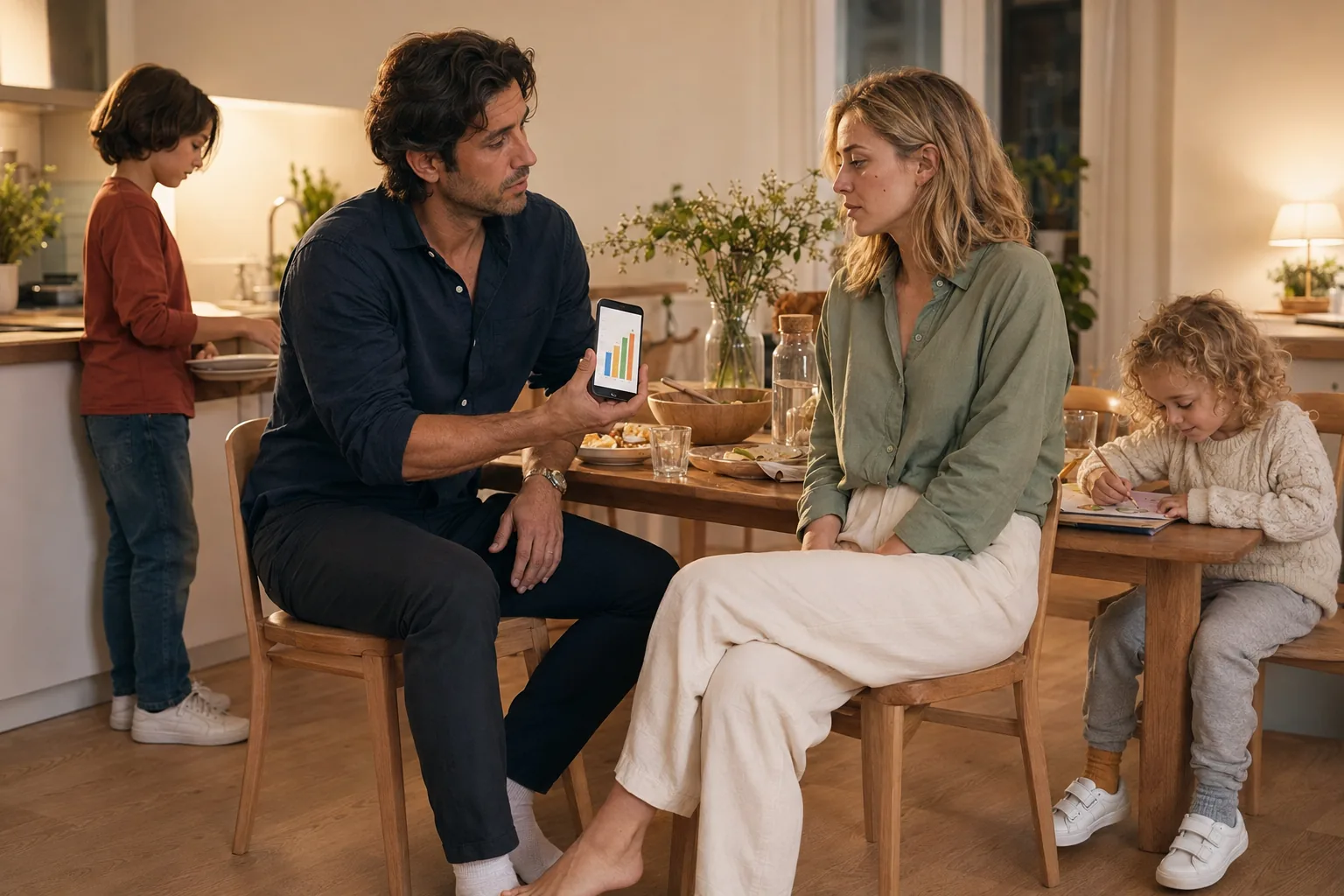
The phone lies on the table between the plates, the screen still lit. “Look at this,” says one of them, turning the display towards the other. On it is a chart the app draws every week on its own: who has carried how much load this month. The number is precise, colourful, impossible to argue with. And that is exactly why, in this moment, it hurts more than anything either of them could have said out loud.
The one who turned the phone round did not mean it as an attack. For weeks they had told themselves they were exaggerating, imagining it, that they should be grateful for what they had. The number was their way of finally proving to themselves that they were not imagining it. The other looks at it and does not feel proof. They feel a verdict, passed without them and delivered only once it was already final.
Why a number in your hand tempts more than a sentence
Behind most evenings like this there is no bad will and no lie. Behind them is the simple fact that you are both overwhelmed, each noticing it in a different place, and neither of you is making it up. Whoever has spent a long time carrying the feeling that they do more eventually stops trusting that feeling. More than one conversation has taught them that: the other side answers “that's just how you see it” or “you're both right, just from different sides”. That is an honest truth about how memory works, but to someone exhausted it sounds like one more reason to stay quiet. A number from the app then feels like rescue: finally something that cannot be waved off with “that's just in your head”.
And on the other side stands someone who spent weeks doing what they could, and now a chart is telling them it was not enough. That does not feel good even when the number is accurate. Which is exactly why they instinctively hunt for a flaw in it: badly set weights, a forgotten task, a day the app never caught. That is not vanity talking. It is the reaction of someone who feels they were judged without getting a word in before the verdict came down.
It isn't the number lying, it's the moment it speaks
The psychologist John Gottman, whose research on small bids for connection we mentioned in another article, repeatedly warns couples in his work against one particular habit: consciously keeping score of who has done more. Not because the tally is untrue. Because it turns the conversation from “we are a team with a problem” into “me against you, and I have proof”. The moment a winning side and a losing side exist, what the number actually says stops mattering.
The difference between a map and a weapon, then, is not in what was measured. It is in the timing and the intent. The same number, looked at together on a quiet Sunday afternoon when neither of you is trying to beat the other, shows exactly what it is meant to show: where the imbalance sits and what needs redistributing. The same number, pulled out on a tired Wednesday evening in the middle of tension, no longer informs. It rules.
Map vs. weapon
Map: you look at it together, calmly, before any conflict arrives. It shows what is uneven, not who has failed.
Weapon: one of you pulls it out mid-argument to prove they are right. The same number suddenly reads as a verdict.
The difference: is not in what the number says, but in when and why someone showed it.
Why it happens even to couples who mean well
Nobody sits down to breakfast planning to use numbers as a weapon that day. It happens gradually, almost unnoticed. First someone logs things just for themselves, to get their own head straight. Then comes a day when they are tired and unheard, and the sentence “just look at the numbers” slips out before they have thought it through. In that second, the tool that was meant to be a shared map gets used, for the first time, as one-sided proof.
That moment is usually what decides which way measurement goes in that household from then on. If it gets used as a weapon once and nobody names it, the other side learns to fear the numbers in advance. They stop looking at them openly and start treating them as something that can be used against them at any time. At that point even the most accurate measurement becomes useless, because one of the two people has stopped trusting it.
How to have the numbers without it hurting
The first thing this requires is an agreement made in advance, not mid-conflict: when do we look at the shared map. A weekly family meeting works well for exactly this reason. It has its own slot, away from any argument, so within it a number can be what it is meant to be: a basis for deciding, not ammunition.
The second thing is a simple rule you both agree on in advance: the number does not get pulled out during a row. When a tense moment arrives, the sentence “let's come back to that at the meeting” is not dodging the issue. It is protecting the map from quietly turning into a weapon. Just as important is asking together why a number looks the way it does, instead of one of you explaining it alone in your own favour. Every task has three phases, noticing, deciding and doing, and most disagreements about the numbers happen precisely because one partner only ever saw the last one.
The third thing is the hardest, but protects trust the most: when a number surprises or unsettles someone, the first response belongs to curiosity, not defence. Not “that's set up wrong”, but “show me exactly what this is counting”. The difference between those two sentences decides whether measurement becomes a shared tool, or a reason one of you avoids it forever.
When the numbers become shared
A household where measurement works as a map looks, from the outside, no different from one where it once became a weapon. The physical work is split the same way, the chart shows the same numbers. The difference is in what happens the moment one partner opens it. In one household, the other leans in closer. In the other, they stiffen. That is the one gauge no app will ever show you, only the other person's face.
Measurement does not hurt anyone by itself. What hurts is how it gets used at the moment one of you is most vulnerable. The difference between a map and a weapon is not decided by the app, but by whether you look at the number together, or one of you points it at the other.
That is why Family Fair Play never surfaces the fairness index as a verdict popping up mid-day: it only shows up where both partners choose to go and look for it themselves. Whether it becomes a map or a weapon is never decided by the app, but by the moment someone opens it.
When the Score Becomes a Weapon: frequently asked questions
How do I stop using chore numbers against my partner?
Do not pull them out mid-argument as proof you are right. Agree in advance on when you look at the shared map together, for instance at a family meeting, and leave the numbers out of the argument itself. A number that appears in calm shows up as a map. The same number, pulled out in anger, sounds like a verdict.
Why does a measurement hurt more than an ordinary reproach?
Because it reads as objective proof, not as one person's opinion. A reproach can be waved off with "that's just how you see it", but that defence does not work against a number, so the other person ends up feeling convicted rather than heard.
Does that mean chores should not be measured at all?
No. The difference is not whether you measure, but when and why you both look at the number. A measurement the two of you review together, calmly, to see what is uneven, stays a map. It only becomes a weapon the moment someone uses it to win an argument.