In 1989, sociologist Arlie Hochschild published a book that put a name on something that until then had none. She studied households where both partners held paid jobs, then looked at what happened to their time once they walked back through the door. The answer was simple and uncomfortable: for one of them, that was exactly when a second shift began. Not rest, not free time. More work, just without a pay slip and without a clock-out.
The number from her research made it into textbooks: over a year, the partner carrying the second shift put in roughly an extra month of twenty-four-hour days compared with the other. Not because that partner worked any less hard during the day. Because that partner's day never actually ended at home.
Hochschild measured one country at the end of the 1980s. Unpaid domestic work has since been collected under a single definition across almost a hundred countries — and in the measured data that gap has not gone away. Its size changed, not its direction.
A threshold your body never registers
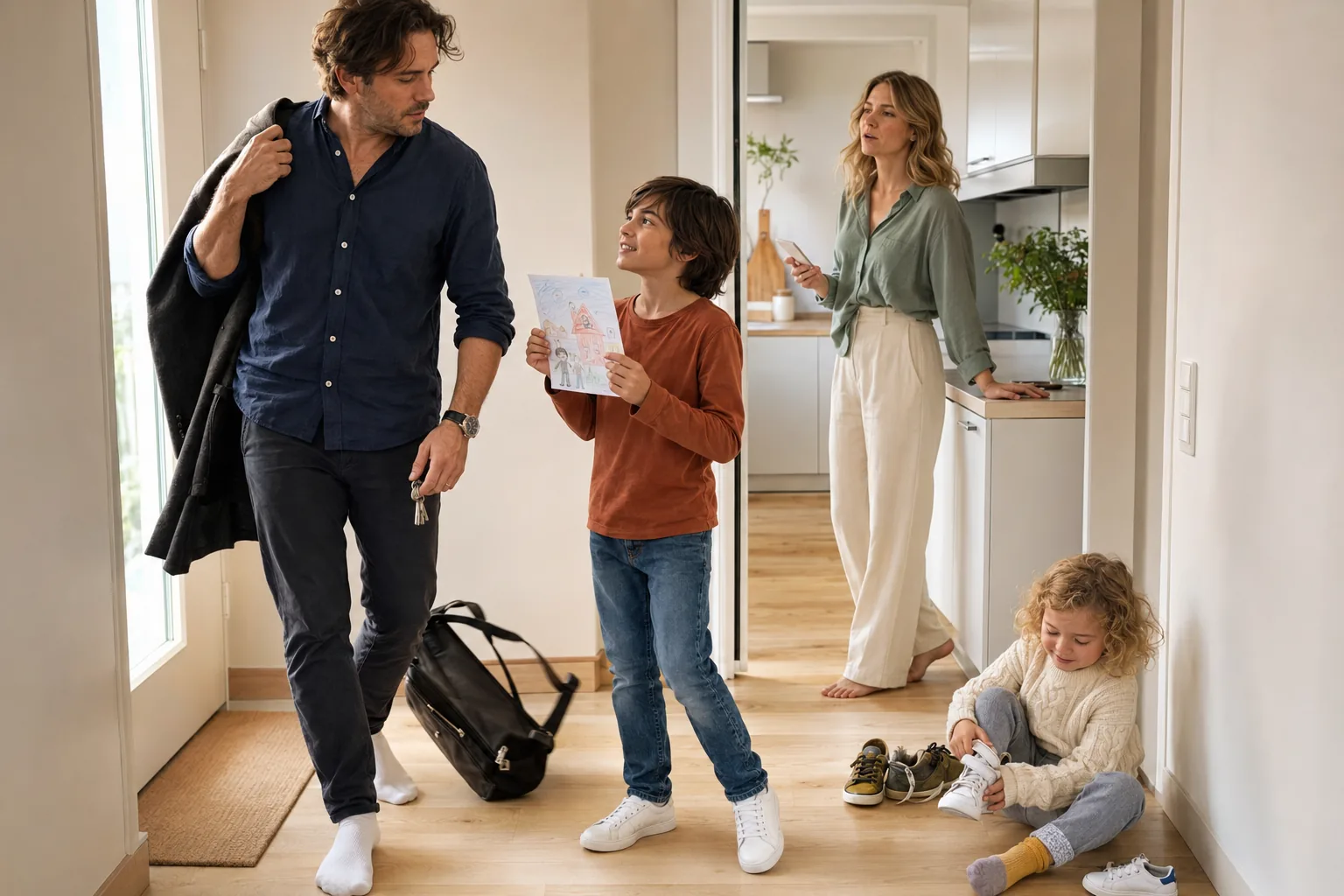
Picture the exact moment: key in the lock, bag off the shoulder onto the floor, coat still on. In that same second, someone is already asking about a form that needs signing, mentioning there's nothing for dinner, or announcing that the younger one is crying because the older one grabbed a toy. Between the end of one shift and the start of the next, there's no break. There isn't even a line.
That's exactly what makes the second shift different from an actual shift change at work. On a factory floor, someone else clocks in to replace you, and you leave. At home, nobody replaces you. Only the task changes, along with the pace and the number of people who suddenly need something from you at once. The body often doesn't register the switch at all, and the mind even less.
It isn't about who works harder
Once the second shift gets named out loud, it's easy for the conversation to slide into a contest over who's more hard-working. That isn't the point, and it doesn't lead anywhere. In a household where the second shift exists, both partners are usually putting in an honest day's work. The difference isn't in effort during the paid job. It's in what happens the moment it ends.
Whoever clocks into the second shift almost automatically, often doesn't even experience it as a decision. It was simply always that way, ever since the first child or the first shared lease, which is exactly why it can be named without blame: nobody consciously chose this arrangement. It just started once, and it never got interrupted.
Why it lands on the same person almost every time
Part of the answer is in how memory works for both partners. Ask someone to recall their own share of the housework, and what comes back first is what they did themselves. That's called availability bias: your own effort is far more available in memory than the effort you only witnessed. Which means both partners can honestly feel their second shift is heavier than what the other one carries, and both can be right at once, just about a different slice of the same workload.
The other part sits in the structure of the work itself. It isn't only about who washes the dishes or who gets the kids dressed. Housework runs through three phases: someone has to notice that something needs doing, someone has to decide when and how, and only then does someone actually do it. The second shift doesn't start at the sink. It starts in the car on the way home, when one partner is already running through what's for dinner, whose homework is due, and whether the daycare needs anything tomorrow. While one partner is still shutting down a work laptop, the other's second shift is already well underway, before they've even stepped out of the car.
When a shift like that never ends and never rotates, the outcome is predictable. The day stretches with no visible edge, and only in hindsight does someone realise they've been running on empty for months, even while looking, from the outside, like they were simply managing fine.
What helps once the shift actually gets an end
A factory solves shift changes with something simple: a roster, where it's clear in advance who clocks in when. Most households have no such roster, so the second shift gets solved from scratch every single day, silently, inside one person's head, where nobody else can see it. The first real improvement sounds almost too simple: give at least part of the second shift a place both partners can see, not just the one currently working it.
It doesn't need to be a perfect schedule. A shared map of what actually happens once everyone is home is enough: who cooks, who takes over the kids, who's tracking what still needs sorting that day. Once that map exists outside a single head, the second shift stops being one person's invisible obligation and becomes recognisable work the other partner can pick up too, without needing to be asked.
One more small thing helps, something households without a roster almost never allow themselves: a few minutes between shifts. Not an hour, just enough for the body and the mind to register that one job has ended and the next hasn't started yet. Even a short pause at the door decides whether the second shift begins already exhausted, or at least a little ready.
An evening that stops being a second job
Once the second shift has an edge, and once at least part of it moves to a place both partners can see, surprisingly little changes on the surface. The dishes still need washing, the kids still need help with homework, and someone still has to get dinner on the table. What changes is who's thinking about all of it, and from what point in the day.
The second shift doesn't disappear — a household still needs things done after the paid job ends. What disappears is the same person carrying it alone, every day, with no rotation and no moment to exhale between the door and the kitchen.